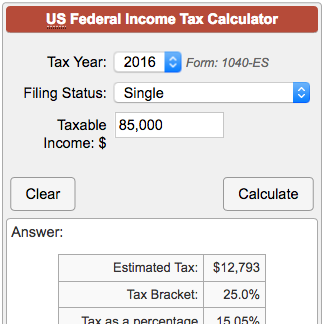
Use this free tax return calculator to estimate how much you'll owe in federal taxes, using your income, deductions and credits — in just a few steps.
We believe everyone should be able to make financial decisions with confidence. And while our site doesn’t feature every company or financial product available on the market, we’re proud that the guidance we offer, the information we provide and the tools we create are objective, independent, straightforward — and free.
So how do we make money? Our partners compensate us. This may influence which products we review and write about (and where those products appear on the site), but it in no way affects our recommendations or advice, which are grounded in thousands of hours of research. Our partners cannot pay us to guarantee favorable reviews of their products or services. Here is a list of our partners.
Which bracket you land in depends on your filing status: single, married filing jointly, married filing separately, and head of household. Choosing the right filing status can have a big effect on how your tax bill is calculated.
Deciding how to take your deductions — that is, how much to subtract from your adjusted gross income, thus reducing your taxable income — can make a huge difference in your tax bill. But making that decision isn’t always easy.
The standard deduction is a flat reduction in your adjusted gross income, the amount determined by Congress and meant to keep up with inflation. Nearly 70% of filers take it, because it makes the tax-prep process quick and easy.